
|
Donations Please send your donations to: Islamic Center Of The South Plains PMB 333 |
ICSP BLOOD DRIVE
There will be a blood drive on Friday, January 13, 2012 after the Jumuah prayer, insha'Allah. It will be conducted by United Blood Services. Sign up sheets are available at the entrance of the masjid to let the donors select the convenient time slot for blood donation.
FAMILY NIGHT DINNER
Please join us for the family night dinner this Saturday, January 7, 2012 at 6 p.m. Please bring some food to share with your brothers and sisters.
WELCOME BACK, STUDENTS
We like to welcome all the students who are returning for the Spring semester at TTU, LCU and SPCC.
Membership Drive:
We are currently updating our membership directory. Please fill out the attached membership form (pdf or zipped word) and either drop it at the masjid donation box or send it via email to Sheikh Samer.
For more information on membership types and eligibility requirements please read the ICSP by-laws.
The ISCP weekend school will resume classes from Sunday, January 8, 2012. Classes run from 11 a.m. to 2 p.m. every Sunday. Please contact the Islamic Center at 806-797-8026 for registration and other information.
|
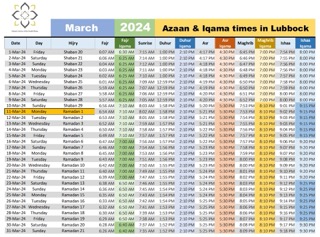
Prayer |
Time |
|---|---|
|
Fajr |
6:30 a.m. |
|
Dhuhr |
2:00 p.m. |
|
Asr |
4:00 p.m. |
|
Maghrib |
6:00 p.m. |
|
Isha |
7:30 p.m. |
The Jumuah Prayer is held at 2.00 p.m. at the ICSP main masjid and 1:15 p.m. at the student masjid (or the Islamic Cultural and Student Center, which is located at 2222 15th Street, just a few blocks East of the Texas Tech campus).
This website is to communicate to you the news relating to our Muslim community of Lubbock, and some useful information on Islamic faith and culture.
Our community is composed of few hundreds of Muslim professionals and students from the US and other countries around the world. It is the kind of nice, harmonious and active community you would like to live with and raise your children within.
Our website will, insha'Allah, provide you with information about the schedule of worship , education and social activities at the Islamic Center of South Plains, and other activities of the community groups, such as the Muslim Students Association (MSA) at Texas Tech University. We hope that you will find our website instructive and helpful.
WEEKLY ACTIVITIES AT THE ISLAMIC CENTER (MAIN MASJID) LOCATED AT 3419 LA SALLE AVENUE, LUBBOCK |
||
|---|---|---|
Weekly Special Halaqa for the Sisters (in English) |
Every Sunday |
From 3 p.m. to 4 p.m. |
Weekly Seerah Class |
Every Friday |
After Maghrib |
Weekly Tafseer of the Qur'an |
Every Saturday |
From Fajr to Shurooq (sunrise) |
Weekly Special Halaqa for the Sisters (in Arabic) |
Every Wednesday |
From 12 p.m. to 2:00 p.m. |
Weekly Quran/Tajweed class |
Every Sunday | From 11 a.m. to 12 p.m. |
|---|
WEEKLY ACTIVITIES AT THE ISLAMIC CULTURAL CENTER (STUDENT MASJID) LOCATED AT 2222 15TH STREET, LUBBOCK |
||
|---|---|---|
Weekly Fiqh class (registration needed) |
Every Tuesday (tentative) |
Between Maghrib and Isha |
Weekly Arabic class |
Every Thursday | From 6 p.m. to 8 p.m. |
MSA Halaqa |
Every Wednesday | From 7 p.m. to 9 p.m. |
|---|
A reflection on divine love
Hamza Yusuf
Many Muslims believe that the idea, "God loves everyone," is simply wrong and incongruous with Islamic teachings. Verses abound in the Qur'an decrying those God does not love: liars, hypocrites, oppressors, the arrogant, boastful braggarts, and those who love praise for that which they have not done, among others. Reading these verses, it is easy to begin to resent such people and to believe that God does not love everyone. However, if we look closely at these people, we see elements of ourselves in them. What is true of any man is true of all men; the only difference is in the degree to which it is true. Prophets and sanctified saints are the only exceptions to this universal truth. Jesus, peace be upon him, states, as recorded in al-Muwatta' of Imam Malik (d. 179/795): "Do not, like lords, look upon the faults of others. Rather, like servants, look after your own faults. In truth, humanity is comprised of only two types of people: the afflicted and the sound. So show mercy to the afflicted, and praise God for well-being." It is never the sinner that one should hate, but only the sin; for the essence of all humanity is a soul created in submission to its Creator. Whether that soul acknowledges this on a conscious level or not is a matter of grace, and this understanding enables us to look at others with compassion. All people, everywhere and throughout time, suffer great tribulation at various points in their lives. At this very moment, hearts are breaking and lives are being shattered, women abused, children violated, and people dying while their loved ones are crying. Also at this very moment, other hearts are rejoicing, babies are being born, mothers are nurturing, smiles are given freely, charity is being distributed, and lovers are uniting. The airport is one of the great metaphors of our time: sad, happy, and indifferent faces are all to be seen there, as people part with loved ones, greet their beloveds, or simply wait to pick up or let off people they barely know. Sad, happy, and indifferent are the states that sum up our collective body of souls. In the next life, however, there is only bliss or wretchedness, joy or sorrow-no indifference.
How to Build Islamic Attitude, Knowledge and Skills?
Dr. Habib Siddiqui
Islamicity
Stanwood Cobb was a Harvard educated historian who lived and taught in Istanbul, Turkey nearly a century ago. In 1914 he published a book, based on his experiences in the Orient. In his book "Islamic Contribution to Civilization", he writes: "As I moved among the common people I was particularly struck with their serenity and calm at all times. Along the quai of the Bosphorus, for example, one had an opportunity to see the difference in temperament which set the Muslim trader apart from his competitors. While others were always on the watch for customers, shouting loudly and waving as they saw potential patronage, and often jumping out of their boats in order to induce trade, the Muslim sat in lordly calm, waiting in peace for whatever customer Allah willed to send him. Actually, this attitude was more persuasive to us than the hurry-scurry of the Greek and Armenian boatmen, whom we brushed aside in order to reach the boat of a Turk. This Muslim attitude of immense calm in the midst of the life of commerce was even more noticeable in the Istanbul bazaars. There many of the rug merchants sat in front of their bazaars in order to entice passers-by. But the Turkish rug dealers sat calmly on a platform in the rear of their bazaars, not deigning to move until you had found a rug you were interested in and asked them its price. It was the custom of the Turk to name a price about twenty-five per cent more than normal, and come down to normal in the course of that bargaining which then was an indispensable element of commercial life in the East. On the other hand, it was the custom of many other rug merchants to name to greenhorns a price three or four times greater than normal.
By Imam Abu Hamid Al-Ghazali
In an environment with increasing distractions how do we make our prayers more beneficial for our selves? Following is an excerpt from "Inner Dimensions of Islamic Worship", a compilation of Imam Ghazali's works that can inspire us to develop humility and become closer to God through prayer. God, says in the Quran: 'And perform the Prayer in remembrance of Me.' [Ta Ha, 20:14] 'Do not be one of those who are neglectful.' [al-A'raf, 7:205] 'Do not approach the Prayer when you are intoxicated, until you know what you are saying.' [al-Nisa', 4:43] Some say that 'intoxicated' means inebriated by many anxieties, while others say it means drunk on the love of this world According to Wahb, the meaning is obviously a caution against worldly attachment, since the words 'until you know what you are saying' explain the underlying reason. Many are those who pray without having drunk wine, yet do not know what they are saying in their Prayers! Prophet Muhammad said: 'If a man performs two cycles of Prayer without the distraction of any worldly thought, all his previous sins will be forgiven.' (al-Bukhari/Muslim) 'Prayer is nothing but submissiveness, humility, supplication, sighing and remorse, holding out your hands and saying: "O God! O God!" Otherwise it is fruitless.' (al-Tirmidi/al-Nasai) In the earlier scriptures, we find these words attributed to God, Glorified is He: 'I do not accept the Prayers of everyone who prays. I accept the Prayers of none but those who are humble before My Majesty, who are not arrogant towards My servants, and who feed the poor and hungry for My sake.'